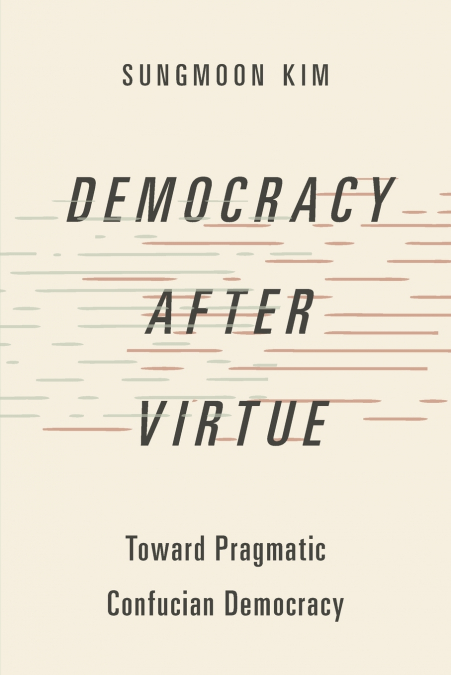
DEMOCRACY AFTER VIRTUE
 POD

DEMOCRACY AFTER VIRTUE

SUNGMOON KIM

61,64 €
IVA incluido
Editorial:
OXFORD UNIVERSITY PRESS
Materia
Politica
ISBN:
9780197528280
61,64 €
IVA incluido
Añadir a favoritos

Is Confucianism compatible with democracy? Ongoing debates among political theorists revolve around the question of whether the overarching goal of Confucianism--serving the people's moral and material well-being--is attainable in modern day politics without broad democratic participation and without relying on a "one person, one vote" system. One side of the debate--voiced by "traditional" Confucian meritocrats--argues that only certain people are equipped with the moral character needed to lead and ensure broad public well-being. They emphasize moral virtue over civic virtue and the family over the state as the quintessential public institution. Moreover, they believe that a system of rule headed by meritorious elites can better handle complex modern public affairs than representative democracy. The other side--voiced by Confucian democrats--argues that unless all citizens participate equally in the public sphere, the kind of moral growth Confucianism emphasizes cannot be fully attained. Despite notable differences in political orientation, scholars of both positions acknowledge that democracy is largely of instrumental value for realizing Confucian moral ends in modern society. It would seem that Confucians of both types have largely dismissed democracy as a political system that can mediate clashing values and political views--or even that Confucian democracy is a system marked by pluralism.In this book, Sungmoon Kim lays out a normative theory of Confucian democracy--pragmatic Confucian democracy--to address questions of the right to political participation, instrumental and intrinsic values of democracy, democratic procedure and substance, punishment and criminal justice, social and economic justice, and humanitarian intervention. As such, this project is not only relevant to the much debated topic of Confucian democracy as a cultural alternative to Western-style liberal democracy in East Asia, but it further investigates the philosophical implications of the idea and institution of Confucian democracy in normative democratic theory, criminal justice, distributive justice, and just war. Ultimately, Kim shows us that the question is not so much about the compatibility of Confucianism and democracy, but of how the two systems can benefit from each other.

Artículos relacionados

  • TRES RAZONES DE ESTADO
    COSMER SÁNCHEZ
    Napoleón codificó Francia. Bismarck inventó Alemania Alejandro helenizó el mundo. Todos ellos se concentraron en el juicio de la historia; pensaron en siglos. Eso es un estadista: quien comprende que su obra se consagra en las naciones fundadas; quien sabe que las leyes son su espada, la moral su escudo, y el tiempo su único juez.Al Perú le urgen estadistas, líderes capaces de ...

    10,92 €

  • LA POLÍTICA QUE NO FUE
    LUIS ARIAS RUIZ
    Hubo una generación que creyó que podía cambiarlo todo. Y durante un tiempo, lo hizo. O eso parecía.Entraron en política para acabar con lo de siempre. Para romper inercias. Para abrir las instituciones y devolverlas a la gente. Pero lo que encontraron dentro no era tan distinto de lo que habían prometido combatir.Este libro cuenta lo que pasa cuando la ilusión se convierte en ...

    18,67 €

  • CUANDO EL INFORTUNIO SE CONVIERTE EN INJUSTICIA
    LAS LUCHAS ACTUALES DE LOS DERECHOS HUMANOS POR LA IGUALDAD SOCIAL Y EN SALUD
    En Cuando el infortunio se convierte en injusticia, Alicia Ely Yamin entrelaza la teoría y la experiencia de primera mano en una narrativa convincente acerca de cómo la evolución de las normas legales, las políticas económicas y los paradigmas de desarrollo han interactuado en las luchas por la salud y la justicia social. En esta segunda edición —revisada y ampliada—, Yamin inc...

    39,52 €

  • ENTRE EL MONOPOLIO Y LA CONVERGENCIA
    MATÍAS JACKSON
    Mientras el mundo debatía el futuro de internet, Uruguay eligió el silencio. La neutralidad de la red —el principio que impide a los proveedores de internet favorecer contenidos, servicios o empresas— fue uno de los temas más controversiales de la política digital en las últimas dos décadas. En Estados Unidos, Europa y América Latina se generaron leyes, conflictos regulatorios ...

    9,88 €

  • BABEL 2.0: LA HUMANIDAD REESCRITA
    ALEXA PORTI
    Babel 2.0: La Humanidad Reescrita no es solo un libro de análisis, es una alarma espiritual y profética para nuestro tiempo. Desde las antiguas páginas de Génesis hasta los experimentos más recientes de Neuralink, este texto conecta los hilos invisibles de la historia para mostrar cómo el proyecto humano de autoexaltación sigue vivo bajo nuevas formas.Aquí, descubrirás cómo las...

    18,72 €

  • DIOSAS, HÉROES Y LABRIEGOS
    DIEGO AUFIERO
    ¿Qué cuentan los billetes cuando los miramos con atención? Este libro propone una lectura singular de la iconografía monetaria del peronismo clásico, entre 1946 y 1955. A través del análisis de emisiones, bocetos y proyectos inconclusos, Diego Aufiero reconstruye cómo el Estado argentino buscó narrarse a sí mismo en el papel moneda: sembradores, héroes libertadores, alegorías d...

    18,20 €